
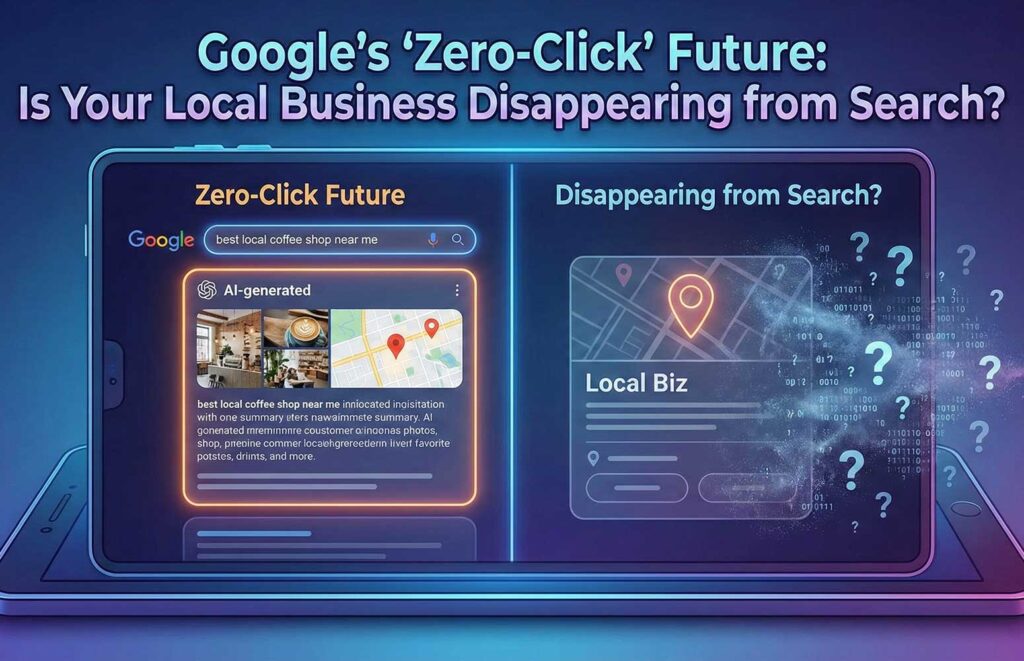
I. Google’s ‘Zero-Click’ Future: Is Your Local Business Disappearing from Search? Byline: Mark Medeiros
You don’t have to “imagine” a world where Google answers questions instantly—we are already living in it.
It’s called Zero-Click Search. It is Google’s ambition to satisfy users right on the search page, meaning they never have to visit your website. Research suggests over 60% of searches now end without a single click.
While the tech press calls this a “better user experience,” I call it a crisis for local businesses.
At my agency, Slocum Studio, we are seeing this shift impact real traffic data for clients across Massachusetts right now. If your strategy is still just “getting clicks,” you are fighting a losing battle. Here is precisely what is happening and how we are advising clients to pivot.
It’s Google’s grand ambition: instant gratification, a digital reflex arc where question begets immediate answer. And it’s becoming increasingly dominant. Consider this: research suggests well over 60% of searches now conclude without a single click to an external website.
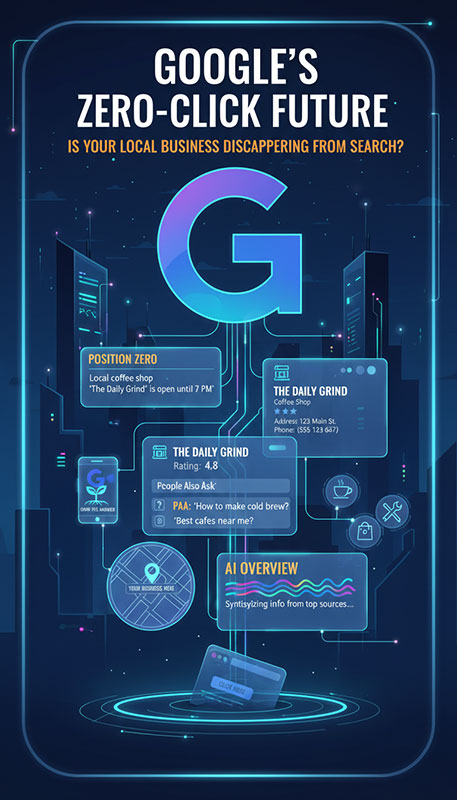
How does Google orchestrate this feat of digital prestidigitation? Through a suite of features designed to keep you within its walled garden, bathed in the glow of the SERP (Search Engine Results Page):
Featured Snippets: The coveted “Position Zero,” where your answer leaps from the digital ether, demanding attention
- Direct Answers & Knowledge Panels: Facts, figures, definitions, meteorological forecasts, biographical details – a veritable cornucopia of information served à la carte.
- Local Packs & Map Packs: The digital storefront for your neighborhood café, displaying operating hours, contact details, and navigational cues, all within Google’s embrace.
- “People Also Ask” (PAA): An ever-expanding constellation of related queries, drawing you deeper into the informational vortex.
- AI Overviews (SGE): The vanguard of this zero-click revolution, wielding the power of artificial intelligence to synthesize complex information and present it in digestible form.
- Google’s Ecosystem: YouTube, Maps, Shopping – all designed to ensure you remain within the family, never straying beyond the corporate embrace.
II. A Trip Down Memory Lane: How We Got Here
The journey from a humble directory of links to a sophisticated answer engine is a testament to Google’s relentless pursuit of informational dominance. In the nascent days of the internet, search was a simple affair: a list of links, ranked by relevance. But Google’s ambition was always grander.
Consider these key milestones in the evolution of zero-click search:
- 2005: The genesis of Google Local (now Google Business Profile), a pivotal moment in placing local businesses firmly on the digital map.
- 2012: The advent of Knowledge Panels, offering at-a-glance information and transforming search from a list of links to an informational gateway.
- The 2010s: The gradual but inexorable rise of PAA, Local Packs, and rich snippets, enriching the search experience while simultaneously diminishing the imperative to click.
- 2020-2021: The inflection point where the “zero-click” trend began to exert its influence, casting a shadow over the traditional SEO landscape.
- 2023-2024: The arrival of AI Overviews (SGE), powered by cutting-edge AI such as Gemini and MUM, forever alters the dynamics of information retrieval.
- 2025: The integration of AI Mode with an AI chatbot tab, blurring the lines between search engine and digital assistant.
Underlying this transformation is a series of algorithmic updates, each designed to refine and enhance Google’s ability to provide direct answers: Panda, BERT, MUM, Passages Ranking – all striving for better, faster, more relevant information. And, of course, the ascendance of E-E-A-T (Experience, Expertise, Authoritativeness, and Trustworthiness), Google’s guiding principle for ensuring the quality and veracity of its AI-generated responses.
III. The Big Debate: Love It or Hate It? Current Opinions & Controversies
The rise of zero-click search has ignited a fervent debate, pitting the interests of users against those of content creators and businesses. Is this a utopian vision of instant information, or a dystopian landscape where independent websites wither and die?
- The Marketer’s Headache: The traditional metrics of SEO – clicks, traffic, engagement – are becoming increasingly irrelevant. Success is now measured in impressions, visibility, and brand recognition, even in the absence of direct traffic.
- The Traffic Tumble: Publishers and content creators are experiencing a palpable decline in organic traffic, leading to accusations of content appropriation by Google.
- Google’s Defense: The company maintains that its primary goal is to improve the search experience for users, conveniently glossing over the potential impact on the broader digital ecosystem.
- The Numbers Game: The debate rages on regarding the true prevalence of zero-click searches. Google claims that website visits are on the rise, while others assert that the majority of searches now conclude on the SERP.
- Legal & Ethical Minefield: The implications of zero-click search extend beyond mere economics, raising profound legal and ethical questions.
- Antitrust Alarms: Concerns persist that Google is leveraging its market dominance to stifle competition, favoring its own products and services while marginalizing independent websites.
- “Content Theft”: The practice of extracting content for featured snippets raises questions of copyright and fair use, particularly for news organizations and small-scale creators.
- Undisclosed Risks: Lawsuits, such as the one involving Reddit, allege that Google’s AI-driven changes have inflicted harm on online platforms without adequate transparency or justification.
IV. Your Local Business: Disappearing or Dominating?
For local businesses, the rise of zero-click search presents a paradox: a double-edged sword that can either lead to obscurity or unlock unprecedented opportunities.
Challenges:
- Website Woes: Decline in website traffic translates to fewer opportunities for direct engagement, sales, and data collection.
- Stiff Competition: The battle for coveted placements in local packs and featured snippets is fierce, requiring a concerted and strategic effort.
- Measuring SEO Success: Traditional metrics are becoming less reliable, necessitating new approaches to tracking and evaluating performance.
Opportunities:
- Free Street Cred: Appearing in a local pack or knowledge panel confers instant credibility and enhances brand visibility.
- Foot Traffic Booster: Providing instant access to directions, phone numbers, and hours of operation can translate into tangible real-world visits.
- Hyper-Local Power: Google’s emphasis on local results creates a unique opportunity to connect with nearby customers.
- Streamlined Customer Journey: Facilitating direct calls or visits without unnecessary clicks enhances the overall customer experience.
So, how can local businesses navigate this evolving landscape and emerge victorious? Here is some expert advice:
- ✓Master Your Google Business Profile (GBP):Treat your GBP as your digital storefront, ensuring it’s accurate, up-to-date, and engaging.
- ✓Be the Answer Engine:Create content that directly addresses common customer questions, optimizing for featured snippets and AI Overviews.
- ✓Schema Markup is Your Friend:Leverage structured data to help Google understand and display your information accurately.
- ✓Diversify, Diversify, Diversify:Explore alternative channels, such as social media, email marketing, and paid advertising.
- ✓Brand, Brand, Brand:Cultivate a strong, trustworthy brand that resonates with both customers and Google’s AI algorithms.
- ✓Reviews are Gold:Actively manage and encourage positive reviews across all platforms.
V. Peeking into the Crystal Ball: What’s Next for Zero-Click Search?
The future of search is inextricably linked to the ongoing evolution of artificial intelligence. As AI becomes more sophisticated, we can expect even more comprehensive direct answers, blurring the lines between search engine and personal assistant.
- AI Takes the Wheel: Generative AI, exemplified by AI Overviews, will continue its ascendancy, providing increasingly nuanced and personalized responses.
- Voice Search Dominance: The proliferation of smart speakers and AI assistants will further amplify the demand for instant, conversational answers.
- Visual Revolution: Expect a surge in the use of images, videos, and augmented reality within search results, transforming the search experience into a more immersive and interactive one.
- Beyond Keywords: Entity-Centric SEO: Building your brand’s authority and presence in Google’s Knowledge Graph will become paramount.
- The AI Wars: The competitive landscape will intensify as ChatGPT, Gemini, and Bing Copilot vie for dominance in the “zero-click” ecosystem.
- New Metrics, New Strategies: Traditional metrics will give way to new measures, such as “share of SERP presence” and brand mentions in AI-generated content.
- Your Website Still Matters: While zero-click search will continue to grow, your website will remain a vital hub for complex queries and transactions.
- The Future is “Own the Answer”: The ultimate goal is not merely to rank in search results, but to become the definitive source of information for your customers.
The days of “set it and forget it” SEO are over. Optimizing for Zero-Click Search requires constant vigilance—updating schema, managing reviews daily, and feeding Google’s AI with fresh answers. It is a full-time job, but it shouldn’t be yours.
At Slocum Studio, we manage this entire “Answer Engine” workflow for local businesses. We ensure Google trusts your brand enough to feature it, so you can focus on serving the customers we send your way. [Stop disappearing from search—let’s audit your visibility today.] Slocum Studio

Mark Medeiros is the founder of Slocum Studio, a Massachusetts-based agency helping businesses integrate AI. He also writes at MarkMedeiros.com.”