
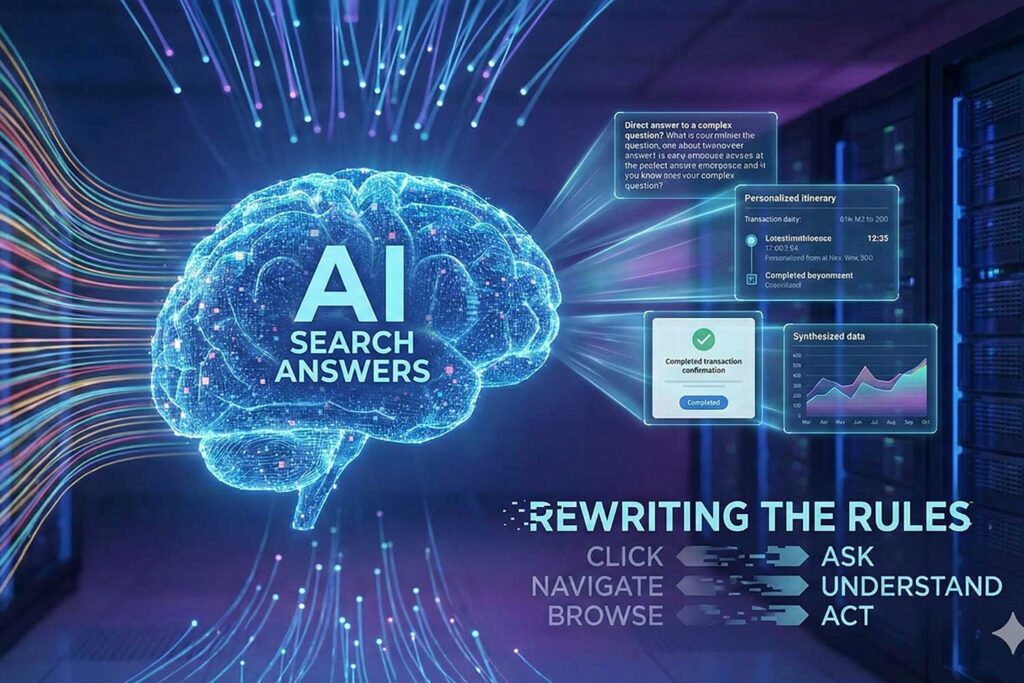
We are entering an era dominated by AI search answers. It’s a massive shift. In fact, at my agency, Slocum Studio, we’ve totally overhauled how we build websites to keep up with it. Here is what you need to know..
Remember endlessly scrolling through pages of “blue links” in a desperate quest for the information you needed? Picture this: those days are fading, perhaps faster than we realize.
We’re now entering an era dominated by AI search answers – exemplified by Google’s AI Overviews – that offer direct, synthesized information, moving beyond a mere lists of links.
This isn’t simply about finding keywords; it’s about understanding you and your underlying intent. Search engines are evolving into intuitive entities that understand the nuances of language and the subtleties of your queries.
Why should you care?
This isn’t just a minor tweak to your online experience; it’s a seismic shift, a fundamental change in how we discover information and how businesses connect with their audiences. It’s a change that compels us to re-evaluate the very fabric of the internet as we know it.
The days of “set it and forget it” SEO are over. Optimizing for Zero-Click Search requires constant vigilance—updating schema, managing reviews daily, and feeding Google’s AI with fresh answers. It is a full-time job, but it shouldn’t be yours.
At Slocum Studio, we manage this entire “Answer Engine” workflow for local businesses. We ensure Google trusts your brand enough to feature it, so you can focus on serving the customers we send your way. [Stop disappearing from search—let’s audit your visibility today.] Slocum Studio
II. From Punch Cards to PageRank: A Quick Trip Down Search History Lane
Let’s journey back to the dawn of digital discovery, an era of clunky search engines like Archie and AltaVista. These early pioneers relied on pure keyword matching, a rudimentary system that often left users drowning in irrelevant results.
Then came Google, armed with PageRank, a revolutionary algorithm that introduced the concept of “importance.” PageRank wasn’t just about keywords; it analyzed the network of links, giving weight to pages that were referenced by other credible sources. This was a watershed moment, laying the groundwork for the smart search we know today.
Even early on, there were baby steps into what would become AI. Simple spelling corrections and translation features started showing an ability to understand language and meaning, setting the stage for the future.
Major milestones followed:
- Knowledge Graph (2012): Suddenly, search engines could offer direct facts about entities, transforming from a link provider to an information provider.
- RankBrain (2015) & BERT (2019): These advancements marked a significant leap in Natural Language Processing (NLP), enabling search engines to truly understand the intent behind our queries, even the most nuanced and complex ones.
- Generative AI Arrives: The recent leap to AI Overviews and conversational search, making engines feel like smart assistants. This is the culmination of decades of progress, resulting in search experiences that are both intuitive and informative.
III. The Good, The Smart, and The Instant: Today’s AI Search Experience
We now live in an age of smarter search buddies.
- Context is King: Thanks to NLP, AI can now decipher the context of your questions, even those laden with ambiguity.
- Instant Answers: “Zero-Click Results” provide summaries and quick facts directly on the search results page, eliminating the need to click through multiple links.
- Comprehensive & Interactive: AI weaves together information from diverse sources, offering a holistic view of the topic at hand. Furthermore, you can engage in follow-up questions, refining your search in real-time.
- Sources, Sources, Sources: Reputable AI search platforms still prioritize transparency, providing clear attribution for the information presented, allowing users to delve deeper into the original sources.
The major players in this arena include Google’s AI Overviews, Bing Copilot, and emerging challengers like Perplexity AI, each vying to redefine the search experience.
IV. Navigating the Minefield: Controversies & Criticisms Rocking the Boat
However, this technological revolution is not without its controversies.
- The “Hallucination” Horror Stories: AI, in its quest to provide answers, sometimes fabricates information, confidently presenting falsehoods as facts. We’ve all heard the stories of AI recommending glue as a pizza ingredient or suggesting that people eat rocks.
- Why It Happens: This stems from a combination of factors, including flawed training data, models that are overly eager to please, and a lack of real-world common sense.
- The Bias Backlash: AI, trained on vast datasets of human-generated content, can inadvertently reflect and amplify societal biases. This can manifest as gender bias in image searches or discriminatory outcomes in hiring algorithms. Furthermore, personalized results can create echo chambers, limiting exposure to diverse viewpoints.
- Publishers in Peril: The Traffic Tsunami: The rise of “zero-click” results poses a significant threat to content creators, who are experiencing massive drops in traffic and ad revenue.
- “Zero-Click” = Zero Revenue?: When users get their answers directly from the search results page, they have no incentive to click through to the original source, depriving publishers of valuable traffic and revenue.
- Content Theft? Some publishers feel that their intellectual property is being used without fair compensation, as AI scrapes and synthesizes their content without proper attribution or revenue sharing.
- The Transparency Gap: The lack of transparency surrounding AI Overviews and their impact on website analytics adds to the frustration, leaving publishers in the dark about how their content is being used and how they can adapt.
- SEO’s Existential Crisis (or Evolution?): The traditional rules of Search Engine Optimization (SEO) are being rewritten as AI-powered search prioritizes authoritative content and direct answers.
- The Old Rules Don’t Apply: Achieving high rankings is no longer sufficient if users never click through to your website.
- The New Game: “Answer Engine Optimization” (AEO) focuses on creating highly authoritative, unique content that AI wants to cite as a source.
- Humans Still Needed: Despite AI’s capabilities, it still struggles with nuance, creativity, and the “why” behind searches, ensuring that human SEO professionals remain relevant.
- Ethical Quandaries: Beyond bias, concerns linger regarding data privacy, the spread of misinformation, and the question of accountability when AI makes mistakes.
V. Glimpses of Tomorrow: The Future of AI Search
The future of AI search is rife with possibilities:
The Rise of the Super-Assistant: Search engines are evolving into proactive, conversational AI agents that understand complex intent and can even complete tasks on your behalf.
- Seeing, Hearing, Searching (Multimodal Magic): Expect seamless integration of text, voice, images, and video in your searches, creating a truly immersive and intuitive experience (think Google Gemini).
- Hyper-Personalization on Steroids: Search results will be tailored to your exact preferences, location, mood, and even the device you’re using.
- New Contenders, New Rules: More specialized AI search engines are emerging, challenging Google’s dominance and offering privacy-focused alternatives.
- Google’s Next Moves: Expect continuous, rapid integration of AI across all its search products as Google strives to maintain its competitive edge.
- Addressing the Elephants in the Room: Ongoing efforts are focused on combating hallucinations (Retrieval-Augmented Generation) and bias, as well as improving transparency and accountability.
VI. Conclusion: Riding the AI Search Wave (or Drowning in It?)
AI search is an unstoppable force, reshaping our digital world in profound ways.
- For Users: AI search offers unparalleled efficiency, but it also demands a greater emphasis on critical thinking and source verification.
- For Businesses & Creators: Adapt or be left behind. Focus on creating unparalleled quality, fostering direct audience engagement, and exploring innovative monetization models.
- The Human Touch: Despite AI’s increasing capabilities, the need for human expertise, empathy, and ethical oversight remains paramount. This is a partnership, not a replacement. The future of search lies in harnessing the power of AI while preserving the essential human elements that make it truly valuable.
The days of “set it and forget it” SEO are over. Optimizing for Zero-Click Search requires constant vigilance—updating schema, managing reviews daily, and feeding Google’s AI with fresh answers. It is a full-time job, but it shouldn’t be yours.
At Slocum Studio, we manage this entire “Answer Engine” workflow for local businesses. We ensure Google trusts your brand enough to feature it, so you can focus on serving the customers we send your way. [Stop disappearing from search—let’s audit your visibility today.] Slocum Studio
AI search is already changing how people find and trust businesses online—and that shift is only accelerating. At Slocum Studio, the focus is on turning those changes into an advantage for you: structuring content so AI assistants can actually quote your brand, building WordPress sites that load fast and speak “machine language” as well as human, and weaving practical AI into your marketing so you capture fewer, but far more qualified, clicks.
Suppose you are ready to future‑proof your website for answer engines, AI overviews, and whatever Google launches next. In that case, Slocum Studio can help you map the strategy, implement the tech, and measure what matters—leads, calls, and real customers, not just traffic.

Mark Medeiros is the founder of Slocum Studio, a Massachusetts-based agency helping businesses integrate AI. He also writes at MarkMedeiros.com.”