
By Mark Medeiros, Blogger, SEO and AI Specialist, Slocum Studio
I. Hold Up, What Are We Even Talking About?
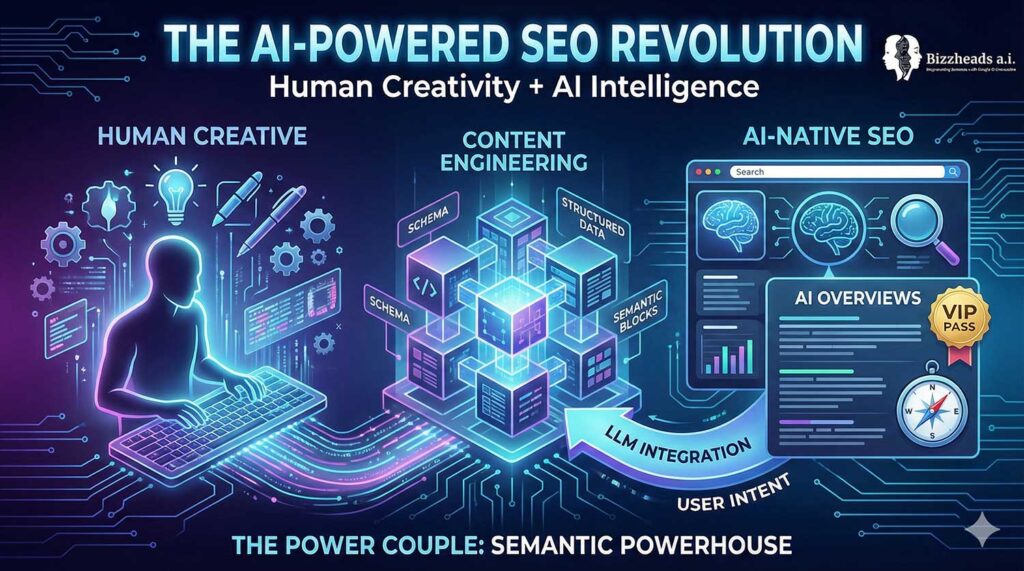
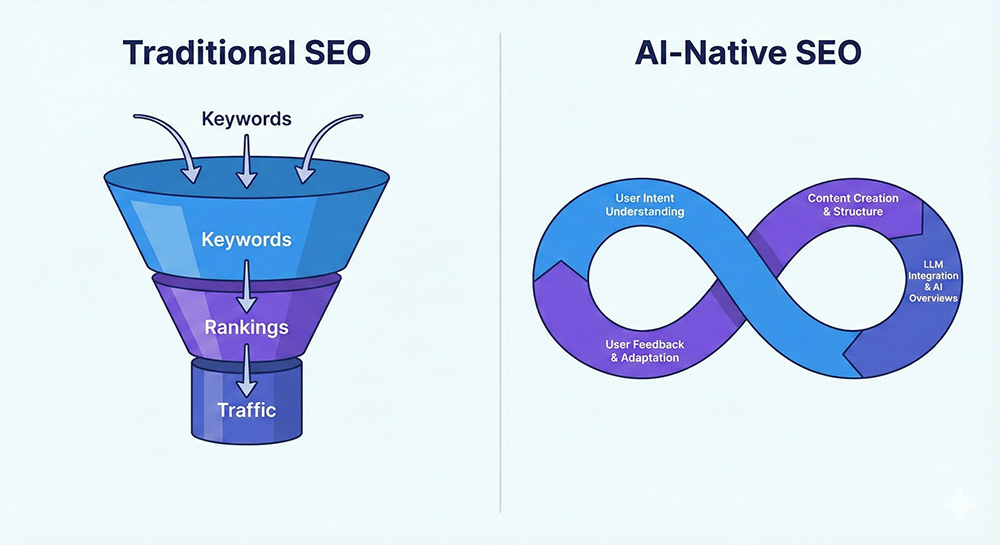
Forget everything you thought you knew about SEO. We’re not just tweaking keywords anymore. We’re talking about AI-native SEO and content engineering – a fundamental shift where content is crafted to resonate with artificial intelligence as much as, if not more than, it does with human readers.
AI-Native SEO: Your Brainy Co-Pilot. This isn’t about slapping AI tools onto your existing workflow. It’s about building your entire SEO strategy with AI at its core. Think about it: understanding user intent at a granular level, anticipating the questions they haven’t even typed yet, and scaling content creation in ways previously unimaginable. This is content that’s not just indexed by Large Language Models (LLMs); it’s best friends with them, earning a VIP pass to Google’s AI Overviews and becoming an indispensable part of the AI-driven information ecosystem.
Content Engineering: The Architect of Awesome Content engineering is where we take your raw content and transform it into meticulously structured, machine-readable blocks – think of it as turning your words into semantic LEGO bricks. It’s about employing structure, enriching content with metadata, and implementing Schema.org markup with precision. Why? Because AI needs clarity. It needs to understand the context, the relationships between concepts, and the nuances of your message. Content engineering ensures your content is not just present but perfectly understood and delivered flawlessly across various platforms.
The Power Couple: The true magic happens when AI-native SEO and content engineering unite. Your content transcends mere information; it becomes a semantic powerhouse, ready to conquer any challenge the AI-driven landscape throws its way.
II. Once Upon a Time in the Digital Age…
The OG AI Whispers: The seeds of today’s AI revolution were sown long ago, with Alan Turing’s musings in the 1950s and the Dartmouth Workshop in 1956, which officially established the field of “Artificial Intelligence.” These early pioneers laid the foundation for the data-crunching marvels we see today.
The Internet’s Wild West Meets Early AI (1990s-early 2000s): The internet’s nascent years saw machine learning algorithms, such as Support Vector Machines (SVMs) and early Natural Language Processing (NLP) techniques, begin to identify patterns within the growing digital landscape. Google’s introduction of PageRank in 1998 marked a pivotal moment, shifting the focus from simple keyword stuffing to the quality and authority of content, as measured by its network of backlinks. Meanwhile, Amazon pioneered personalized recommendations, offering the first tantalizing glimpse of AI’s potential to tailor content experiences.
The Deep Dive & Language Revolution (2010s): Deep learning emerged, catapulting neural networks and language understanding to unparalleled heights. The introduction of Transformer models in 2017, exemplified by BERT and GPT in 2018, revolutionized how computers processed and understood human language. Google’s BERT update signaled a move away from superficial keyword matching, prioritizing contextual understanding and semantic relevance.
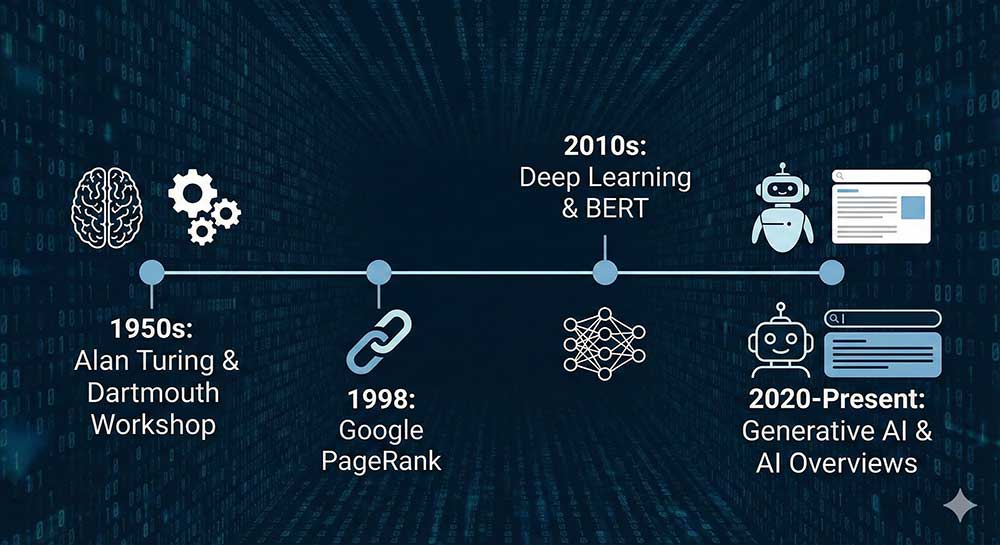
The AI Explosion (2020-Present): The introduction of GPT-3, ChatGPT, DALL-E 2, GPT-4, and Gemini unleashed a plethora of generative AI capabilities that seemingly transformed content creation overnight. In the realm of SEO, AI overviews emerged, emphasizing direct answers and conversational search, while E-A-T (experience, expertise, authority, and trustworthiness) became an indispensable benchmark for content quality.
III. What’s the Word on the Street?
AI: Friend, Not Foe: The consensus is clear: AI augments human capabilities; it doesn’t replace them. Think of AI as your tireless research assistant, your brainstorming partner, and your content generator – all rolled into one.
The “AI-Native Pro”: A new breed of SEO specialist is emerging – individuals who don’t just use AI tools but design strategies and workflows with AI firmly at the core.
The Golden Rules for AI-Powered Content:
- Humans First, AI Second: Let AI handle the initial drafts, but always let human expertise refine the final product. Emotional intelligence, creativity, and your unique brand voice are irreplaceable.
- E-E-A-T is Your Mantra: Experience, Expertise, Authoritativeness, and Trustworthiness are paramount. AI can identify patterns, but humans deliver the substance.
- Prompt Engineering is Your Superpower: Mastering the art of communicating with AI is crucial. The better your prompts, the better the output.
- Structure, Structure, Structure: Employ clear headings and structured data to make your content easily digestible and displayable by AI.
- Always Be Watching: The AI landscape evolves rapidly. Monitor performance metrics and adapt your strategies accordingly.
The Vibe Check: Cautious Optimism:
- The Good News: Unprecedented efficiency, boundless content ideas, and insights that were previously unattainable. Plus, Google’s explicit affirmation that “quality content is quality content, regardless of its origin!”
- The “Uh Oh” Moments: Generic content, factual inaccuracies, plagiarism risks.
- The dreaded “AI echo chamber,” where everything sounds homogenous.
IV. The Dark Side of AI: Controversies and Headaches
- To Disclose or Not to Disclose? The debate surrounding transparency in AI-generated content continues. Should you inform readers that AI played a role in its creation?
- “Did AI Just Make That Up?” The accuracy challenge looms large. AI’s propensity to “hallucinate” facts and disseminate misinformation necessitates rigorous fact-checking protocols.
- Originality on the Line: Is AI-generated content genuinely unique, or is it merely a derivative remix of existing material? The lines between originality and plagiarism become increasingly blurred.
- The “Thin Content” Trap: Overreliance on AI can lead to bland, shallow content that offers little value, risking penalties from Google and disengagement from your audience.
- Bias, Spam, and Ethical Minefields: AI can inherit biases from its training data, and unscrupulous marketers may attempt to exploit it for unethical SEO practices.
- Google’s Ultimatum: The focus is not on who authored the content but on its helpfulness, reliability, and user-centricity. Spammy or unhelpful content, regardless of its origin, will be penalized.
V. What’s Next on the Horizon?
- Search Engines Get Even Smarter: Expect enhanced semantic understanding, personalized search results, and a stronger emphasis on Knowledge Graph entities rather than just keywords.
- The Reign of AI Overviews: Content must be meticulously optimized to be extracted and cited directly in AI-generated search answers (a new era of Answer Engine Optimization!).
- Automation, Everywhere: AI will streamline technical audits, link building, and other tasks, freeing up human strategists for higher-level initiatives.
- Talk to Me! The growth of voice and visual search demands content that is conversational and easily digestible by virtual assistants.
- The Unbreakable Bond: The future lies not in AI or humans, but in AI and humans. Success hinges on leveraging AI’s capabilities while reinforcing human creativity, empathy, and critical oversight.
FAQs
Traditional SEO often focused on tweaking keywords for rankings. AI-Native SEO represents a fundamental shift where strategy is built with AI at its core. It involves understanding user intent at a granular level and anticipating questions users haven’t even typed yet. The goal isn’t just to be indexed, but to become “best friends” with Large Language Models (LLMs) to earn a spot in AI Overviews.
Content engineering is the process of transforming raw content into structured, machine-readable blocks. The article compares this to turning words into “semantic LEGO bricks.” By employing structure, metadata, and Schema.org markup, you provide the clarity AI needs to understand the context and nuances of your message, ensuring it is delivered flawlessly across platforms.
To succeed with AI content, you should follow these core principles:
Humans First, AI Second: Use AI for drafts, but let human expertise and emotional intelligence refine the final product.
E-E-A-T is Your Mantra: Focus on Experience, Expertise, Authoritativeness, and Trustworthiness.
Prompt Engineering: Master the art of communicating with AI to get better outputs.
Structure: Use clear headings and structured data.
Monitor and Adapt: Keep an eye on performance metrics as the landscape evolves.
No. According to the section “Google’s Ultimatum,” Google focuses on the helpfulness, reliability, and user-centricity of the content, not who authored it. The article notes Google’s affirmation that “quality content is quality content, regardless of its origin.” However, spammy, unhelpful, or “thin” content will be penalized, whether it was written by a human or a machine.
The article highlights several controversies and headaches, including:
Accuracy: AI’s tendency to “hallucinate” facts or make things up.
Originality: The blurring lines between unique content and derivative remixes (plagiarism).
The “Thin Content” Trap: Overreliance on AI leading to bland, shallow content that offers no value.
Bias: This occurs when AI inherits biases from its training data.
As search engines shift toward direct answers and conversational search, we are entering an era of Answer Engine Optimization. Content must be meticulously optimized to be extracted and cited directly in AI-generated answers. Additionally, there will be a stronger emphasis on “knowledge graph entities” rather than just keywords, and a push toward content that is digestible by voice assistants.

The landscape is dynamic and ever-changing. As a blogger, SEO and AI specialist, and owner of Slocum Studio, I, Mark Medeiros, believe that navigating this evolving landscape requires a deep understanding of both the technology and the human element. It’s a fascinating challenge, and I’m excited to see what the future holds.